Core framing:
multi-agent systems are not about adding more AI for spectacle. They are about designing verification, specialization, and escalation into the workflow before autonomy expands.
A single AI agent can answer quickly, fluently, and confidently. The harder question is whether that answer deserves trust when the work touches decisions, approvals, customers, or operational risk.
multi-agent systems are not about adding more AI for spectacle. They are about designing verification, specialization, and escalation into the workflow before autonomy expands.
A single AI agent can produce a polished answer in seconds. That speed is useful for low-risk work, but it becomes dangerous when fluency starts to look like certainty. The real problem is hallucination delivered with confidence, wrapped in the same tone and structure as a correct answer.
For general drafting, brainstorming, or note formatting, one model plus human review is often enough. The risk changes when the task becomes decisional: finance approvals, compliance interpretations, customer escalations, technical operations, or knowledge work that other people will rely on. In those settings, the answer is not the product. The trust boundary is.
The strategic shift is simple: use one agent when speed matters most, and use multiple agents when the cost of being wrong begins to matter more than the cost of waiting.
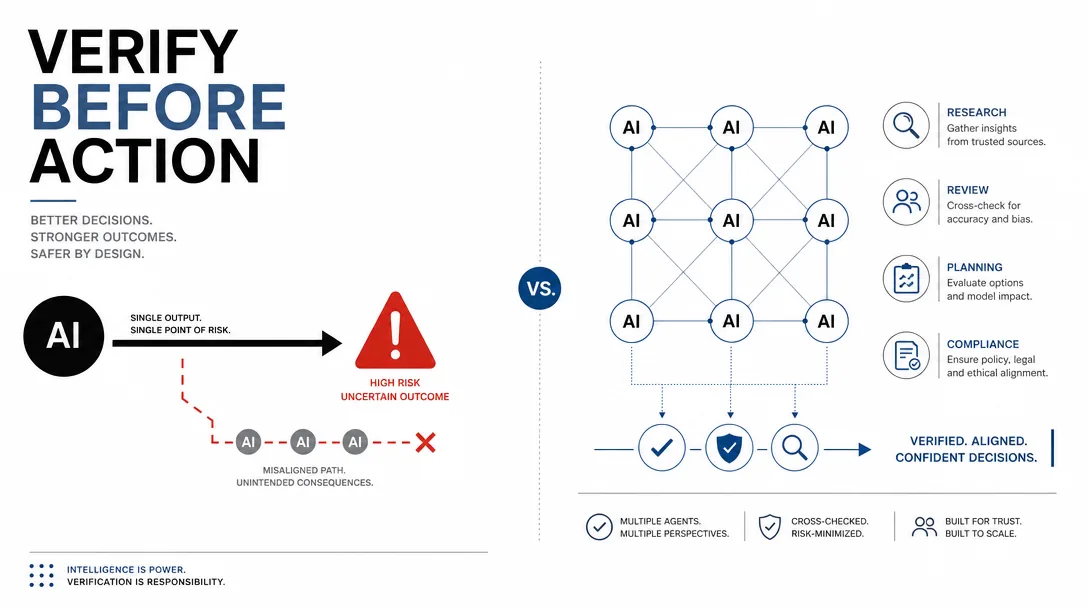
Single-agent design works well when the cost of error is small and correction is obvious. Draft a first email, reformat meeting notes, summarize a short discussion, or produce five headline options. In those cases, a human can scan the output quickly and repair the weak parts without redesigning the workflow.
High-stakes work is different because the agent does not naturally become more cautious when the consequence increases. It keeps producing likely language. It does not automatically pause because a recommendation might affect a customer outcome, a policy exception, or a financial decision. That creates a structural mismatch: language models optimize for response, while critical workflows optimize for verification before action.
Human institutions already understand this pattern. Medicine uses second opinions. Finance uses approval controls. Aviation uses checklists and role separation. Mission control relied on specialist oversight, not heroic improvisation. When consequences rise, verification becomes part of the design.
Single-Agent Workflow
One model receives the prompt, produces the answer, and often presents reasoning in a single smooth narrative. This is fast and efficient for low-consequence tasks, but weak assumptions can remain hidden because generation, judgment, and communication happen inside the same role.
Multi-Agent Workflow
Specialized agents divide the work into evidence gathering, policy review, critique, orchestration, and escalation. The system creates designed disagreement in the places where a confident answer needs pressure before it becomes an operational decision.
A multi-agent system does not solve trust by pretending one model has become omniscient. It improves trust by changing the structure around the answer. One agent may gather evidence, another may apply policy, another may challenge weak reasoning, and an orchestrator may decide whether the work is ready to ship or needs escalation.
This matters because specialization changes failure modes. A general-purpose agent can fail in many directions at once: missing context, overreaching into another domain, applying the wrong rule, or communicating uncertainty too softly. A specialist agent fails within a narrower lane, which makes mistakes easier to detect and correct.
Across more than 1,100 sessions involving 20 agents, reliability improved faster than raw capability when roles became narrower and handoffs became explicit. The lesson is practical: workflow shape determines trust as much as model strength does.
1,100+
Operational sessions used to identify recurring reliability, handoff, and verification patterns across agent workflows.
20
Distinct agent roles provided enough contrast to see how boundaries influence output quality and accountability.
3
Specialization, verification, and orchestration formed the repeatable structure behind the strongest outcomes.
5
Consequence, domain overlap, auditability, policy consistency, and volume determine when multi-agent design pays off.
Reliable multi-agent work routes a task through bounded roles rather than asking one model to generate, judge, verify, and escalate alone.
Define the request, consequence level, and required domains.
Retrieves sources, facts, and operational context.
Checks constraints, rules, and approval requirements.
Challenges assumptions and identifies weak reasoning.
Resolves conflicts, sequences handoffs, and decides readiness.
Handles high-consequence or low-confidence decisions.
Specialization assigns each agent a bounded domain, decision type, or responsibility. The goal is not complexity; the goal is to reduce ambiguity so role drift becomes visible before it creates operational damage.
Boundary clarity: high
Verification asks whether the first answer deserves trust. The right level of checking depends on consequence, not on habit. A social post draft and a compliance recommendation should never pass through the same control design.
Control intensity: consequence-based
Orchestration coordinates specialists so the system does not become a louder version of the original problem. It decides who handles each step, when review is required, how disagreement is resolved, and where context moves next.
Coordination layer: mandatory
Do not start multi-agent design by asking how many agents you can deploy. Start by asking where a wrong answer would create cost, confusion, or customer impact. Then assign roles, reviews, and escalation paths around those risk points so trust is engineered, not hoped for.
The most common mistake is believing that more agents automatically means better outcomes. It does not. Multi-agent systems create value when roles are independent, boundaries are visible, and handoffs are deliberate. Without that structure, extra agents simply multiply noise.
Agent sprawl appears when too many roles can partially answer the same question. Responsibility blurs, handoffs become noisy, and no one knows whose judgment should prevail. False redundancy is subtler: two reviewers inspect the same output, but both rely on the same weak source or flawed assumption. That looks like verification, but it is really duplication without independence.
The third failure is the most expensive: no escalation logic. If the workflow does not define what happens when evidence conflicts, confidence is low, or the decision touches policy, law, or customer impact, the trust problem has not been solved. It has only been distributed.
| Workflow condition | Single agent is usually enough | Multi-agent design adds value |
|---|---|---|
| Low consequence | Formatting, first drafts, quick summaries, idea generation, and tasks where a human can correct errors immediately. | Often unnecessary; added review may increase latency without improving the result. |
| Multiple knowledge domains | Useful for producing a first pass, but weak when the answer blends policy, operations, finance, and customer context. | Strong fit because separate agents can own evidence, constraints, critique, and final routing. |
| Need for auditability | Limited unless the workflow deliberately captures sources, assumptions, and decisions outside the model response. | Strong fit because each role can leave behind decision patterns, exceptions, source references, and escalation outcomes. |
| High volume | Can accelerate throughput, but manual review becomes a bottleneck as task volume rises. | Strong fit when verification rules and handoffs scale better than human-by-human checking. |
| Policy or customer impact | Risky if the agent is allowed to move from language generation into operational recommendation without review. | Strong fit when confidence thresholds and human escalation are explicit. |
The future of AI work will not belong to the tool that sounds smartest in one turn. It will belong to the organizations that design the best conditions for intelligence to check itself.
Policy checks, source validation, and escalation rules reduce the risk of confident but unsupported recommendations.
Role separation helps distinguish evidence gathering, approval logic, and final decision authority.
Specialized review improves consistency when decisions affect refunds, exceptions, or service commitments.
Agents can separate detection, diagnosis, remediation planning, and human approval for high-impact changes.
Structured handoffs leave behind reusable context instead of isolated one-off answers.
The strongest multi-agent systems do more than complete tasks. They create memory. When work passes through defined roles, the organization can store why something was approved, which evidence supported it, what rule blocked it, and where uncertainty remained.
That record becomes a compounding asset. Decision patterns, exceptions, source references, failure modes, and escalation outcomes help teams improve repeated work instead of rediscovering the same lessons. A single agent can produce an answer. A coordinated system can produce an answer and a reusable trail of reasoning.
This is where knowledge work changes shape. The value is traceability across time. Teams that capture the reason behind decisions build operational memory that prompt libraries alone cannot provide.
If the acceptable failure is a small formatting mistake, keep the system simple. If the unacceptable failure is a wrong approval, inconsistent customer decision, undocumented exception, or weak recommendation, design for multiple roles and explicit escalation. The architecture should match the consequence, not the novelty of the technology.
The practical framework is direct: use a single agent for speed, use multiple agents for trust, and add humans where consequence exceeds machine confidence. That does not remove judgment. It makes judgment visible, inspectable, and easier to improve.
Multi-agent systems are not a fashion shift from one AI brain to many. They are a response to a deeper operational truth: intelligence becomes more valuable when it can be questioned. The organizations that win will not be the ones with the most agents. They will be the ones with the clearest boundaries, the strongest verification paths, and the discipline to design trust before scale.