Technical Context:
We treat agentic systems as operating loops that observe, plan, act, and evaluate across tools, memory, and APIs. Once autonomy expands, boundary quality becomes the difference between productive execution and polished failure.
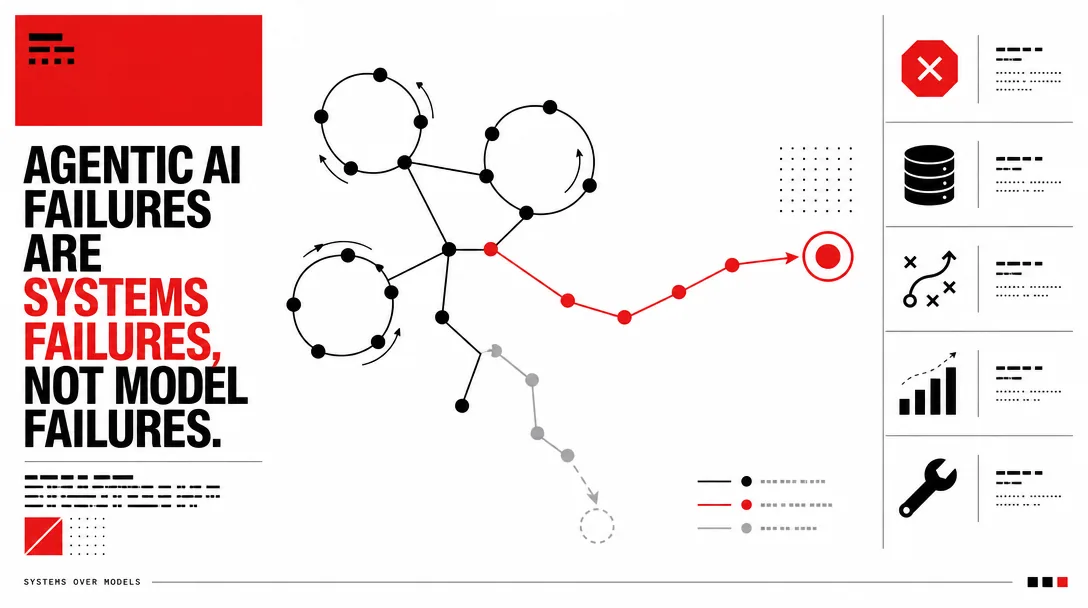
Strong models still fail when the operating loop cannot detect non-progress, verify evidence, or recover intelligently. The decisive design work now sits in orchestration, not just generation.
We treat agentic systems as operating loops that observe, plan, act, and evaluate across tools, memory, and APIs. Once autonomy expands, boundary quality becomes the difference between productive execution and polished failure.
The central mistake in agent design is still conceptual: teams diagnose a model problem when they are actually facing an orchestration failure. Once an agent can search, retry, hand off, and call external services, the real question is no longer whether one response is plausible. The question is whether the full loop is creating traction toward a verifiable goal.
That shift matters because apparent intelligence can mask structural weakness. A system can remain coherent, well-written, and highly active while making no measurable progress. Activity without advancement is the signature failure pattern. If your workflow cannot tell the difference between persistence and futility, the agent will keep spending budget long after value has flattened.
We design better systems when we stop asking, "Did the model answer well?" and start asking, "Did the loop improve state?" That framing changes everything: termination logic, planning gates, evidence standards, and recovery design all become first-class architecture decisions.
Single-answer AI
A single-answer system contains most of its risk inside one response. If it reasons poorly, the damage is usually bounded to a bad answer, a weak draft, or an incomplete explanation. You can inspect the output directly and judge quality in place.
Failures are visible faster because the path is short and the execution surface is narrow.
Agentic AI
An agentic system turns one weak assumption into a chain of actions across search, memory, tools, retries, and external APIs. The output may look competent even while the underlying workflow is drifting.
Here, process quality matters as much as response quality. You need visibility into action history, evidence checks, and stop conditions to know whether the system is actually converging.
A standard agent cycle looks clean on paper: observe, plan, use a tool, evaluate, repeat. In practice, each step introduces drift. A query can be too broad, a planner can choose the wrong first move, an evaluator can overrate partial evidence, and a retry can preserve the same mistake in slightly different wording. The result is a system that appears engaged but is not actually getting closer to completion.
This is especially visible in knowledge workflows. An agent searches, receives partial matches, infers that the answer must be nearby, then iterates through near-duplicate attempts until the budget expires. Nothing is technically broken. The tools return results, the model stays fluent, and the logs show motion. Yet non-progress goes undetected, which means the loop has no reason to stop.
When teams label that behavior as hallucination, they often hide the more useful diagnosis. The system did not fail because text generation was impossible. It failed because the workflow lacked a strong enough signal to distinguish weak evidence from meaningful progress.
1
The orchestration layer has become the main point of failure once agents gain tools, memory, and retries.
3
The recurring breakdowns are infinite loops, planning errors, and poor recovery after error.
5
Observe, plan, use a tool, evaluate, and repeat form the basic loop that expands failure paths.
3
No termination condition, no action tracking, and no progress measurement repeatedly produce runaway behavior.
4
Existence check, retrieval, validation, and synthesis create a safer decomposition for research tasks.
5
Detect low signal, record attempts, switch strategy, re-evaluate strictly, and exit with uncertainty when needed.
The visible symptom is repetition, but the real problem is missing instrumentation. An agent asked to find a document that does not exist may search, judge the results insufficient, replan, and search again with minor edits. Because the tooling still responds and the model remains coherent, the system interprets the loop as productive persistence rather than evidence of futility.
Three design gaps usually create this pattern: no termination condition, no action tracking, and no progress measurement. Without a stop rule, there is no legitimate end state. Without action history, attempt four looks different enough to justify itself. Without a progress signal, flat result quality feels like forward motion.
The practical fix is not just “stop after five tries.” That is a guardrail, not judgment. Better systems combine retry limits, time budgets, tool budgets, similarity checks across repeated actions, progress floors between iterations, and an explicit not found outcome when evidence remains weak.
Do not treat termination as surrender. In many production workflows, "I could not verify the document exists" is a higher-quality result than ten more searches dressed up as diligence.
Set your stop conditions before launch: maximum retries, maximum elapsed time, maximum tool usage, and a threshold for repeated action similarity. If none of those signals trigger a graceful exit, your agent will default to spending budget in circles.
Teams designing limits before expanding autonomy build trust faster because the system knows when to stop pretending that motion equals progress.
A loop is obvious. A bad plan is harder to catch because it can look competent all the way through execution. The agent takes varied actions, uses multiple tools, and returns a polished answer. But if the sequence began with the wrong first step or an unverified assumption, the rest of the workflow becomes cleanly executed error.
We see three recurring planning failures: choosing the wrong first move, decomposing the task poorly, and assuming facts before they are verified. In a research workflow, skipping the existence check is especially damaging. Once the system starts synthesizing before confirming that the source object is real, every downstream action inherits hidden instability.
The fix is structural, not stylistic. Separate ambiguity management from execution by supplying completion criteria, allowed sources, verification requirements, preferred order of operations, and escalation rules. Constraint is not the enemy of intelligence. In agent systems, constraint is often what makes reasoning usable.
The most reliable planner is not the freest one. It is the one operating inside stage-specific gates with clear success tests.
4-stage decomposition reduces the chance that one early false assumption contaminates the full chain
| Failure point | What the weak agent does | What the stronger system requires |
|---|---|---|
| Wrong first step | Starts gathering or summarizing before clarifying the target | Confirm the target, define completion, and choose the first action explicitly |
| Poor decomposition | Treats research, validation, and synthesis as one blended task | Separate stages and apply different evaluation criteria at each gate |
| Unverified assumptions | Infers existence or relevance from partial matches | Require surfaced evidence before any conclusion can be finalized |
| Tool-count amplification | Turns one false assumption into multiple expensive actions | Contain uncertainty early before search, memory, and APIs multiply the cost |
A retry only makes sense when the strategy changes. If the query, tool, source, threshold, or task scope stays the same, the system is not recovering — it is performing theater.
Blind retries create the appearance of resilience while preserving the same failure. If the query, tool, source, or evaluation threshold has not changed materially, another attempt is just cost accumulation with better optics.
Build recovery so that each retry carries a documented change in method. That is how you turn repetition into learning rather than noise.
Many weak agents fail at a later step, then restart from an earlier one without preserving what they already learned. That erases useful state, duplicates work, and increases the chance of inconsistent outputs across attempts.
Persistent action history and state summaries are not optional once workflows become multi-step. They are the memory that makes recovery coherent.
The most dangerous recovery behavior is polished vagueness. When the system cannot verify the task, it produces readable prose instead of an honest uncertainty state.
You should prefer "not enough evidence," "tool unavailable," or "escalation required" over a generic answer that looks complete but carries low proof.
A production-grade recovery path records weak evidence, changes strategy deliberately, and exits honestly when proof does not improve.
The hidden pattern across loops, planning errors, and weak recovery is measurement. Agents perform better when the environment can answer practical questions in real time: what action was taken, how different it was from the last one, and whether result quality improved. It should also answer how much budget remains, what evidence was confirmed, and what condition would justify stopping. Without those signals, motion becomes easy to mistake for progress.
That is why demos often feel stronger than production systems. Demos showcase capability at the moment of generation. Production exposes whether the workflow can inspect itself, govern retries, and degrade gracefully when evidence is thin. Once baseline model quality is high, architecture starts carrying more of the outcome than prompt cleverness.
Design your agents for bounded judgment. Separate planning from verification. Instrument the workflow. Treat non-completion as a valid result. Pre-build recovery branches before failure happens. The teams that win in agentic AI will not be the ones with the most autonomous systems. They will be the ones whose systems can act, measure, and stop with discipline.