NOR-TIC View:
Granite 4.1 and IBM Bob matter because they signal a market correction. Teams that design for repeatable workflow value now will be better positioned when AI and quantum ecosystems begin to converge.
Enterprise AI is moving past the fantasy of one model doing everything. The winning pattern is emerging in plain sight: focused systems, coordinated workflows, and infrastructure that scales across real business constraints.
Granite 4.1 and IBM Bob matter because they signal a market correction. Teams that design for repeatable workflow value now will be better positioned when AI and quantum ecosystems begin to converge.
The most important enterprise AI shift is not model spectacle. It is the end of the single-system bottleneck. Buyers are asking a sharper question now. Can a tool complete a real task at predictable cost, inside an existing process, with enough reliability to trust on Monday morning and not just in a demo? That question changes what wins.
We see Granite 4.1 and IBM Bob as signals of a more disciplined market. Instead of stretching one giant assistant across every use case, the architecture is becoming modular. One component reads tables and charts. Another handles speech transcription and translation. Another follows instructions, calls tools, and manages background execution. That is how enterprise AI starts to look less like novelty and more like operating infrastructure.
The practical implication is straightforward: business value compounds through coordination. A model can be impressive in isolation and still fail in production if it is slow, expensive, hard to govern, or badly matched to the workflow it enters. Teams that understand this early will stop shopping for a miracle and start assembling dependable capability.
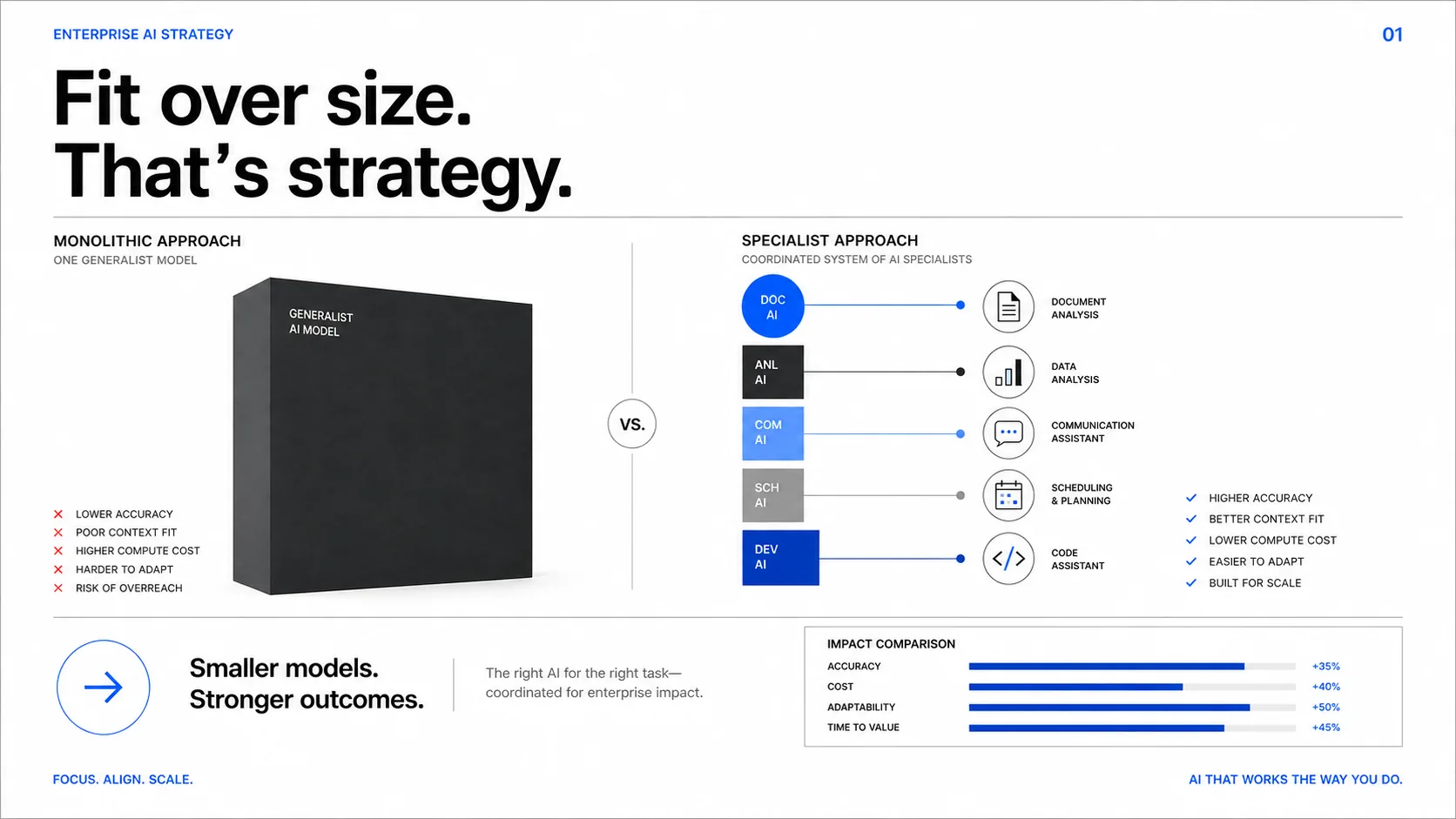
Enterprise teams do not buy intelligence in the abstract. They buy lower error rates, faster cycle times, cleaner handoffs, and fewer fragile steps in work that repeats. That is why Granite 4.1 matters less as a branding event and more as a statement of design philosophy. Use smaller and mid-sized systems where they are sufficient, and reserve broader reasoning only where breadth actually earns its keep.
This is the discipline many AI roadmaps have lacked. For too long, product design has treated capability as a single ladder where bigger always means better. In operations, the real hierarchy looks different. General models create reach. Specialized models create precision. The workflow converts both into usable value. Without that orchestration layer, capability remains expensive potential.
The businesses moving fastest are not chasing maximum breadth. They are isolating recurring tasks that are costly when done poorly. Examples include table extraction from reports, meeting-note generation from recordings, retrieval of facts from internal files, and assembly of outputs that people can act on immediately. Those use cases are not glamorous. They are profitable.
Single giant assistant mindset
One system is expected to read documents, interpret charts, transcribe audio, retrieve internal knowledge, reason broadly, and produce a finished result. This creates hidden fragility: costs rise, governance gets harder, and failures become difficult to diagnose because too much responsibility sits in one place.
Coordinated toolchain mindset
Different tools handle distinct jobs: document reading, speech handling, internal retrieval, instruction following, and final assembly. The result is easier to monitor, easier to swap, and easier to fit into existing work. When one layer improves, the workflow improves without rebuilding the whole stack.
If you want AI to scale, map the transitions between tools before you add more intelligence. Define where data enters, where validation happens, which outputs become inputs, and where a human can intervene. Workflow clarity beats model ambition when the goal is repeatable business performance.
Start with one recurring task that already has clear inputs and outputs. Then assign a focused tool to each step rather than forcing a general assistant to improvise across the whole chain. That is how teams reduce variance without slowing down adoption.
IBM Bob is important because it reflects a product shift we expect to define the next enterprise cycle. The center of gravity is moving away from the chat window and toward the construction layer behind it. Teams increasingly need help connecting tools, shaping task logic, and turning isolated capabilities into applications that survive real operating pressure.
That is a very different value proposition from the early consumer AI era. Back then, interaction was the product. In enterprise environments, interaction is only the surface. The harder problem is making outcomes repeatable across departments, schedules, permissions, and inconsistent inputs. Repeatability is the new frontier.
Think of the difference this way: a clever answer once is entertaining; a dependable result every Monday is strategic. IBM Bob fits the second category. It signals that the market is rewarding systems that help companies build, connect, and maintain process intelligence rather than simply showcase raw model ability.
A practical sales workflow separates jobs cleanly. One tool reads account history, another summarizes prior calls, another retrieves product changes from internal knowledge, and a final orchestration layer assembles the briefing. This structure improves accountability because each output can be inspected before it reaches the next step.
When teams skip this separation, they usually create a brittle assistant that sounds capable but fails under real variation. Structured coordination makes errors easier to trace and easier to correct.
Most failures do not happen because the model is unintelligent. They happen because the workflow around it is undefined: no clear trigger, no quality threshold, no exception handling, and no owner for edge cases. The first demo works because humans compensate manually.
At scale, manual compensation becomes a tax. That is why orchestration tools matter. They turn one-off success into a governed operating pattern.
Buyers should look for observability, modularity, and clean integration surfaces. A useful partner helps teams decide which tasks deserve specialized models, where a broader model is justified, and how to preserve traceability when outputs move across systems.
The strongest platforms will not claim to solve everything. They will make it easier to compose the right stack for each business context.
1 workflow class
High-value document interpretation becomes a dedicated capability instead of an afterthought inside a general assistant.
1 workflow class
Audio-heavy teams gain speed when voice handling is treated as a focused service with clear quality thresholds.
1 workflow class
Background execution matters when AI must call systems, complete steps, and return structured outputs reliably.
The companies that matter most in the next phase of AI may not be the ones with the loudest model launch. They may be the ones that make coordination feel natural.
| Buying Question | What disciplined teams ask | Why it matters |
|---|---|---|
| Capability breadth | Which narrow task does this system perform exceptionally well? | Focused excellence often outperforms broad mediocrity when the task is frequent and measurable. |
| Cost profile | Can we run this at predictable cost across recurring volume? | Enterprise adoption stalls when variable costs make routine use hard to justify. |
| Workflow fit | Where does this tool enter our existing process? | A strong model without a clear insertion point creates friction instead of leverage. |
| Governance | Can we trace outputs, approvals, and failure points? | As systems gain reach, boundary quality becomes decisive for trust. |
| Swap-ability | Can we replace one layer without redesigning everything? | Modularity protects the stack as models improve and procurement priorities shift. |
The next procurement shift is already visible: AI buying is starting to resemble stack design. Teams are selecting writing tools, speech tools, retrieval tools, and orchestration layers based on how each performs inside a larger process. That approach creates more decisions up front, but it also creates a healthier market where products are judged on specific operational value rather than broad branding claims.
This is especially important for privacy, speed, and control. A tool that is slightly less expansive but easier to govern can be the better business choice. The same is true for latency and cost. If a narrower system finishes the job faster and with less expense, the theoretical superiority of a broader model becomes commercially irrelevant.
Buyers should get comfortable with portfolios, not monoliths. One tool for search. One for speech. One for drafting. One for internal retrieval. One for process coordination. When those layers are selected deliberately, AI stops being a single purchase and becomes a managed capability.
The emerging pattern is not mysterious. It is a layered operating model that assigns the right class of intelligence to the right kind of work, then measures output quality at the seams.
Core principle: workflow first, model second
The immediate opportunity is operational. AI improves search, note generation, reporting, form handling, and internal knowledge use by reducing friction at repeat points in work.
Organizations stop expecting one platform to solve everything. They combine focused tools, clearer governance, and orchestration layers that make outputs dependable across teams.
Quantum remains early, but the strategic logic is familiar. Companies that build partner networks, developer trust, and infrastructure before the market peaks often become the coordination hubs later.
The quantum portion of IBM’s strategy matters because it reveals how serious platform builders think. They do not only ask what can be sold this quarter. They ask where future leverage will accumulate if a new field becomes commercially important. That is what ecosystem strategy looks like when it is done well: present-day utility paired with long-horizon positioning.
The closest analogy is cloud computing roughly 15 years ago. Early moves often looked too abstract for everyday operators, yet those moves determined who became central once adoption broadened. The same pattern may unfold here. AI delivers practical workflow value now, while quantum invites partners, developers, and researchers to align around a future foundation.
For readers outside the technology sector, the lesson is simple. Leadership no longer belongs only to whoever invents the breakthrough. It belongs to whoever makes it easiest for others to build on top of that breakthrough. That is how ecosystems turn technical progress into durable market power.