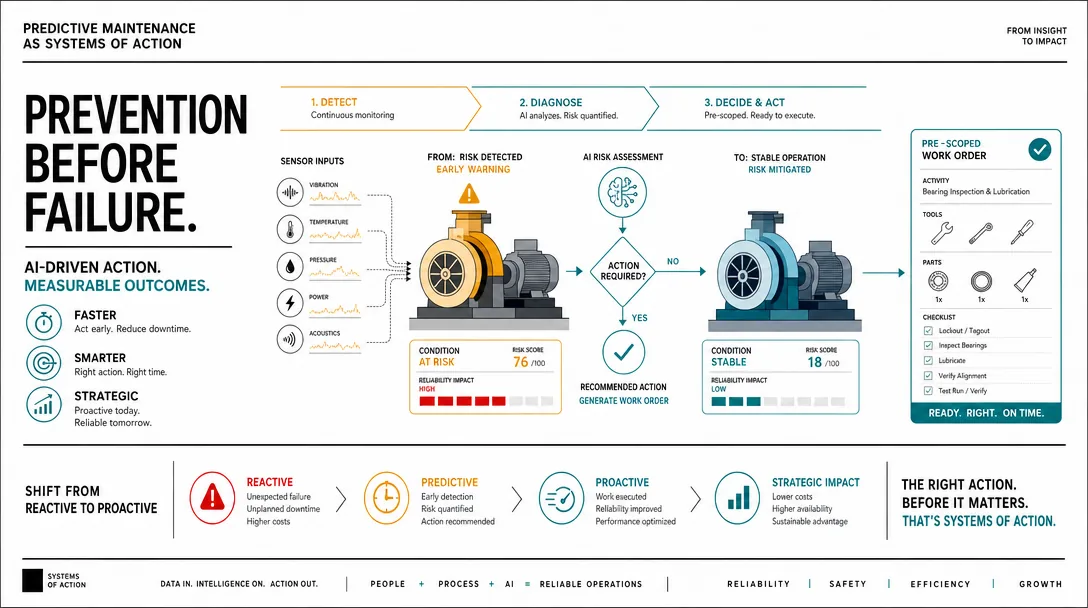
Maintenance changes when software stops acting like a filing cabinet and starts acting like an execution partner. The strategic shift is not more visibility alone, but faster, cleaner, context-aware decisions at the exact moment operational risk begins to compound.
N NOR-TIC10 min read
AI Insights
Automation
Knowledge Management
Workflow
Summary & background
NOR-TIC View:
Agentic capability matters most in environments where every delayed decision expands cost, safety exposure, and rework. Boundary-rich execution beats abstract intelligence every time; the winning teams connect data, procedures, approvals, and field context before they scale autonomy.
In this article4
Maintenance has never been only a repair problem. It is a decision problem disguised as operations. When a pump, aircraft component, bridge sensor, or production line begins to fail, the real damage spreads beyond the asset itself into labor allocation, inventory timing, compliance pressure, and executive risk. Failure multiplies through the system long before finance reports the impact.
That is why we no longer treat progress as better dashboards or larger record sets. The meaningful shift is from systems of record to systems that shape what happens next. Records answer who changed what and when. Action systems help teams decide whether to inspect, replace, defer, escalate, or re-sequence work when constraints collide.
This is the operational hinge. Once software participates in judgment, maintenance stops being a documentation workflow and becomes a managed decision environment.
Traditional maintenance platforms earned their place by preserving history. Asset master data, work orders, inspections, parts records, and service logs create traceability, compliance evidence, and a usable memory of the estate. That foundation is indispensable. But traceability is not triage. A database can prove that work happened without helping a planner determine what deserves immediate attention under pressure.
The toughest maintenance questions are almost never retrieval questions. Teams need to know which repair should move first when labor is constrained, and which failure mode could trigger secondary damage. They also need to know whether parts and skills align before dispatch, and whether a closeout is complete enough to avoid repeat failure or audit exposure. These are trade-off decisions, not lookup tasks.
Rigid automation struggles here. Rules route tickets and send notifications, but the moment field conditions shift, the burden snaps back to a handful of experienced people. That concentration of judgment does not scale.
System of Record
A record system is optimized to store work order history, asset details, inventory state, audit trails, and scheduled plans. It tells you what happened, when it happened, and who touched the process. That makes it strong for governance, but weak when conditions change mid-job and the next best action depends on combining multiple live signals.
Intelligent System of Action
An action system sits on top of those same records and reasons across sensor inputs, procedures, constraints, and job context. It prepares work before login, suggests likely root causes, aligns labor, tools, and parts, and prompts for missing compliance steps while the work is still underway. The architecture shift may be subtle, but the operating effect is dramatic.
Design for decision support, not generic automation
If you want agentic value quickly, start where failure is expensive and the workflow already has structured inputs. Connect asset records, work orders, inventory visibility, and procedures first. Then define approval boundaries so the agent can prepare, recommend, and prompt without creating uncontrolled execution paths.
Do not ask whether the model is impressive in isolation. Ask whether a technician or planner can make a better decision in fewer steps with less context hunting.
02How The Workflow Changes
Prepared work replaces manual reconstruction
In a conventional maintenance flow, planners and managers assemble the job by hand. They inspect the asset history, verify parts, assign labor, review procedures, and push the work order forward through multiple handoffs. Every extra check adds latency, and every missing field raises the odds of delay, misdiagnosis, or wasted dispatch. Preparation debt accumulates silently until the technician feels it in the field.
Agentic workflow changes the starting point. The system can assemble relevant records, identify probable failure patterns, sequence tasks, check parts availability, and build a prepared work package before a human reviewer approves the path. The manager still governs the decision. What changes is the burden: less manual compilation, more informed review.
That shift matters because technicians should not begin with a blank page. They should begin with scheduled work, suggested parts, required tools, diagnostic clues, procedural guidance, and expected compliance steps already in view.
From record capture to guided execution
A linear workflow showing how maintenance moves from historical data into real-time decision support and governed action.
Asset Records
Work Orders
Inventory + Scheduling
Agentic Reasoning Layer
Prepared Work Package
Human Approval
Field Guidance + Closeout Prompts
Connections
Asset Records → Agentic Reasoning Layer
Work Orders → Agentic Reasoning Layer
Inventory + Scheduling → Agentic Reasoning Layer
Agentic Reasoning Layer → Prepared Work Package
Prepared Work Package → Human Approval
Human Approval → Field Guidance + Closeout Prompts
The field layer is where value becomes visible. When a technician arrives on site, context has to travel with them. Voice input, visual capture, and mobile guidance matter because the problem is rarely that procedures do not exist. The problem is procedure retrieval under pressure. In noisy environments, on unfamiliar variants, or during time-sensitive failures, documentation can become operationally distant.
An effective agent narrows likely causes using symptom reports, sensor history, performance degradation, and observed conditions. It can guide the sequence of checks in context rather than forcing people to rely on memory alone. That accelerates diagnosis, improves execution consistency, and makes expertise more portable across the workforce.
Over a 12–24 month horizon, that portability may be the most strategic gain of all.
The larger transition is not from human work to AI work. It is from software that documents operations to software that participates in them.
03Why Quality Of Execution Matters
1
DOWNTIME AVOIDANCE
First ROI lens: reduce unplanned outages and shorten repair cycles before disruption cascades into safety and output loss.
2
LABOR LEVERAGE
Second ROI lens: let experienced staff support more work through prepared orders, guided diagnosis, and in-flow prompts.
3
DATA QUALITY
Third ROI lens: improve closeouts so asset history, parts tracking, planning accuracy, and future diagnosis all strengthen together.
4
RISK COMPRESSION
Fourth ROI lens: reduce compliance gaps, undocumented repairs, and missed inspections that become expensive over time.
Many teams describe the maintenance bottleneck as labor scarcity. We see a deeper issue: decision density. Maintenance compresses many small judgments into a narrow time window. Which symptom matters most, which anomaly is safe to monitor, which part should be swapped now, which note is mandatory for closeout, and which observation changes the scope of work all compete at once.
When those judgments stay concentrated in a few veterans, throughput drops and organizational resilience weakens. Agentic systems do not erase expertise; they extend its reach. That is the credible economic change. The goal is not “AI does maintenance.” The goal is less unassisted judgment per event so capable people can govern more activity without being physically present at every decision point.
This is also why incomplete closeouts deserve more attention than they usually get. A repair can be physically finished while the organization quietly inherits operational debt.
Why incomplete closeouts distort the next cycle
A work order that closes without full parts usage, compliance evidence, inspection notes, or follow-up actions does more than create clerical mess. It corrupts the decision environment the next time the asset behaves badly. The agentic advantage here is timing: prompts happen while the technician is still in the flow of work, not three days later when memory has already decayed.
Missing parts records weaken future planning and inventory confidence.
Skipped compliance steps accumulate audit exposure even when the asset is back online.
Deferred notes reduce diagnostic quality and hide repeat-failure patterns under new descriptions.
Real-time prompts improve execution quality at the moment maintenance data is created.
POINT OF IMPACT: real-time, in-workflow prompting
The operational gain comes from shifting decisions earlier and making them more context-rich.
Decision Point
Reactive Mode
Proactive Agentic Mode
Prioritization
Teams review backlog manually and escalate by instinct when labor is constrained.
The system weighs history, likely impact, parts status, and job context to surface what should move first.
Dispatch readiness
Technicians discover missing tools, skills, or parts after the work is already in motion.
Prepared work packages align labor, tools, parts, and procedural needs before dispatch.
Field diagnosis
People reconstruct the problem from memory, manuals, and fragmented records under time pressure.
Voice, visual, and sensor context narrow probable causes and guide checks in sequence.
Closeout quality
Documentation is deferred, incomplete, or inconsistent once the immediate pressure fades.
The agent prompts for missing compliance steps, notes, and records while work is still active.
04NOR-TIC's read
What conditions make agentic maintenance viable?
Agentic performance depends on accessible context, not model mystique. Teams need reasonably structured asset records, current work order data, usable procedures, and visibility into inventory and scheduling constraints. Context quality becomes decisive once the system begins recommending action rather than simply classifying text.
Where should organizations start?
Start with narrow, high-cost workflows where failure has visible consequences and data already exists in workable form. Connect asset and work order records, improve procedural clarity, expose inventory context, and define approval boundaries before expanding autonomy. Small scope, high consequence produces cleaner learning than broad pilots with fuzzy ownership.
What should teams measure?
Measure execution quality, not only model output. Track whether prepared work reduces delays, whether diagnosis time falls, whether closeout completeness rises, and whether fewer jobs require escalation back to a small expert group. These are the signals that show whether the system is changing operational behavior rather than generating impressive demos.
Step 1
Connect the operational spine
Unify asset records, work orders, procedural content, inventory visibility, and scheduling context so the agent sees the real job, not a partial abstraction.
Step 2
Define governance boundaries
Specify what the system may prepare, recommend, prompt, or execute, and where human approval remains mandatory.
Step 3
Launch in narrow high-cost workflows
Focus on expensive failure paths where faster triage and cleaner closeouts deliver immediate value.
Step 4
Instrument execution quality
Track cycle time, closeout completeness, rework avoidance, and escalation rates to verify operational impact.
Step 5
Expand with discipline
Scale only after context quality, trust, and exception handling prove reliable in the first workflow slice.
The hard constraint is operational context
Do not treat agentic maintenance as a plug-in miracle. If your procedures are stale, your inventory visibility is fragmented, or your asset history is inaccessible, recommendation quality will degrade quickly. Execution layers amplify operational discipline; they do not replace it.
Build the connective tissue first, then let the agent participate where the consequence of better timing is highest.
The maintenance lesson extends far beyond maintenance
Maintenance is one of the clearest proving grounds for agentic systems because the pattern is easy to recognize: expensive assets, partial information, procedural work, skilled labor constraints, and meaningful consequences when action is delayed. Utilities, transportation, manufacturing, aviation, logistics, and infrastructure all share this structure. The pattern generalizes because the economics generalize.
That is the broader enterprise signal. Once an organization has enough operational history to guide action, it should question every workflow that still forces people to start from scratch. The strategic opportunity is not simply to automate tasks. It is to create software that can participate responsibly in live operations, with approvals, context, and recovery paths designed in from the start.
Proactive organizations will not win by giving agents unlimited freedom. They will win by giving them the right context, the right boundaries, and the right moment to act.