Technical Context:
The operational lesson is clear: when language-driven systems gain tool access, boundary quality determines business risk. Treat orchestration frameworks as privileged infrastructure, not developer convenience layers.
Framework incidents like this are not edge cases; they are stress tests of your trust model. We design agent systems assuming orchestration layers will eventually fail, then we engineer boundaries that keep failure small, observable, and recoverable.
The operational lesson is clear: when language-driven systems gain tool access, boundary quality determines business risk. Treat orchestration frameworks as privileged infrastructure, not developer convenience layers.
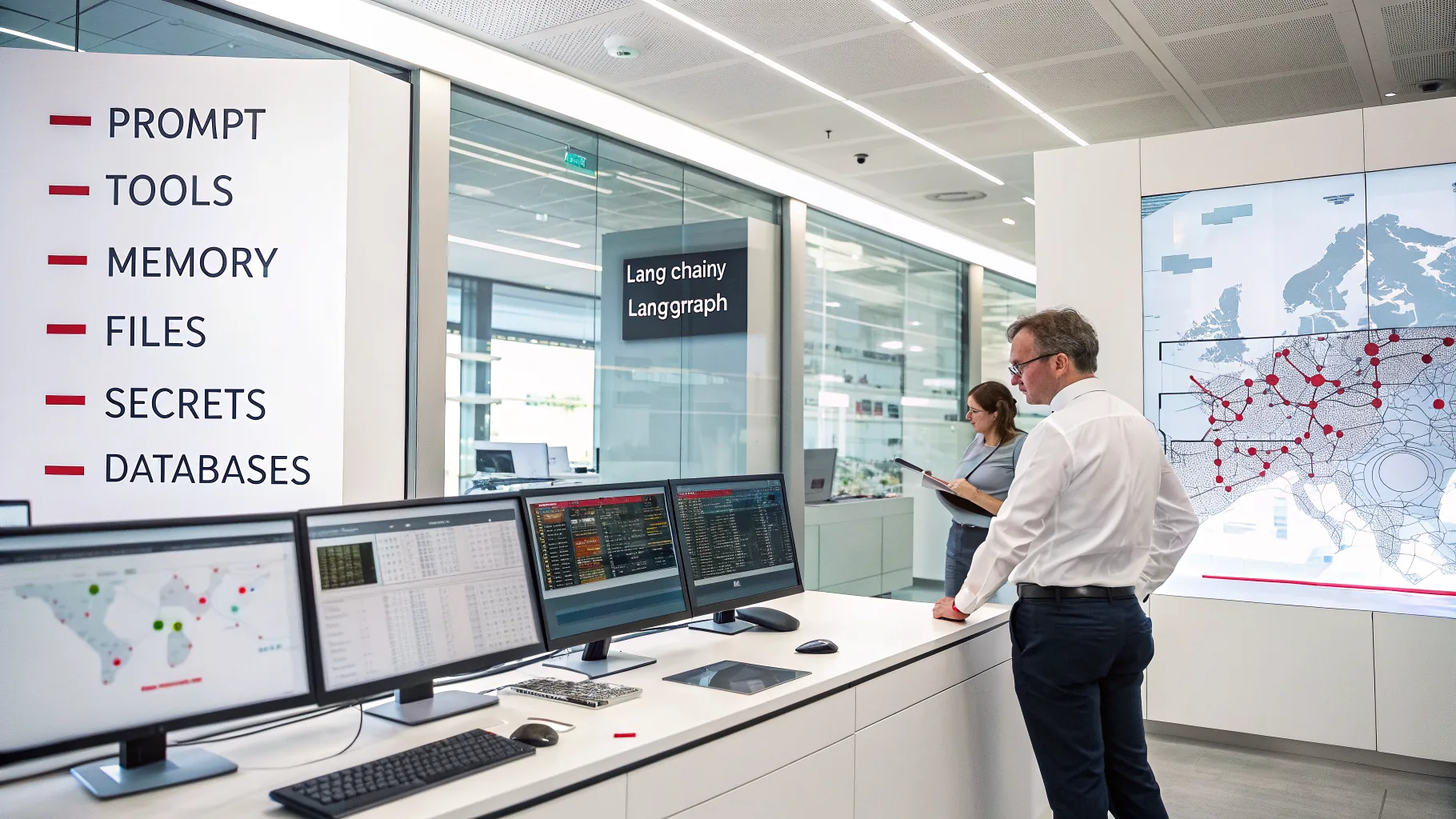
When teams wire LangChain or LangGraph into production workflows, they are not just choosing a framework; they are assigning runtime authority. The incident exposed file paths, secrets, and database reachability because orchestration layers often inherit broad privileges during fast prototyping. That trust rarely gets redesigned before internal copilots become business-critical systems.
The practical shift is simple: stop thinking only about model safety and start enforcing infrastructure safety at the framework boundary. Agents do not need malicious intent to cause damage. They only need an execution path to resources that should have been segmented. In our deployments, the highest-risk moment is the transition from “prompt experiment” to “tool-connected workflow.”
Treat that moment as a formal architecture checkpoint, not a sprint convenience.
Traditional App Vulnerability
Most failures are tied to known layers such as authentication, input validation, or query handling. Blast radius is often constrained by clear service boundaries and established controls. Teams usually know where to patch and which logs to inspect first.
Agent Orchestration Vulnerability
Failures propagate through instruction routing, tool invocation, memory state, and connector permissions at once. The orchestration layer becomes a decision intermediary between language and action. If permissions are bundled by role or container, one flaw can expose files, secrets, and database surfaces in a single incident chain.
3
Host files, runtime/config secrets, and database-connected data were all in potential scope when execution boundaries were weak.
4 Layers
Instruction, execution, permission, and observation boundaries must be engineered together to prevent cascade failures.
4
Workspace overreach, secret shortcuts, unconstrained query paths, and confusion of tracing with true isolation.
Task-Level Segmentation
Permissions should map to specific workflows, not the entire application container or broad agent role.
Most teams over-invest in prompts and under-invest in permission topology. That imbalance creates a quiet hazard: instruction quality improves while the underlying authority model stays coarse. By the time memory, retrieval, and action tools are added, the framework can already reach far more than the business intended.
We use a four-boundary method because it forces explicit design choices. Instruction boundaries define what the model can request. Execution boundaries define what the framework can run. Permission boundaries define what remains reachable if execution misfires. Observation boundaries determine whether anomalies are detected early enough to contain. Boundary completeness matters more than any single guardrail.
If one of those layers is missing, your controls are decorative.
Run a 60-minute blast-radius audit on the live runtime, not your architecture diagram. Enumerate mounted paths, environment variables, active credentials, reachable databases, and outbound network targets. Then remove everything not required for one concrete workflow. This one exercise routinely cuts practical exposure more than adding another monitoring dashboard.
Teams validate UX quickly and often run with permissive defaults to reduce setup friction.
File access, retrieval, and memory are added; orchestration becomes central and quietly accumulates authority.
Databases and internal APIs are connected before strict query boundaries are defined, increasing operational risk.
A framework flaw or routing bug reveals the true permission surface, exposing resources beyond intended scope.
Mature teams shift to task-scoped runtimes, narrow actions, and auditable isolation as baseline architecture.
Mounting broad directories feels efficient in development, but it collapses isolation. Environment files, build artifacts, and internal exports become reachable by pathways that were never designed for sensitive handling. Scope every workflow to approved directories only, and keep secrets physically outside that runtime surface.
Hardcoded tokens and broad environment availability create multiple indirect leak channels. Verbose logs, exception traces, and tool errors can surface credentials without explicit exfiltration logic. Move secrets to scoped brokers and rotate credentials by workflow so one compromise cannot unlock adjacent systems.
Raw or loosely constrained database access turns orchestration defects into business events. Replace broad connectors with read-only views, parameterized actions, and row-level controls. The right question is not whether the agent intends misuse, but whether misuse remains possible under failure.
Tracing helps reconstruction, not prevention. A perfectly logged exploit is still an exploit. Instrumentation must be paired with enforceable isolation controls so abnormal behavior is blocked or limited before sensitive assets are touched.
Operational resilience starts by constraining what the orchestration process can touch at runtime. We treat framework runtime posture as a first-class security artifact tracked alongside deployment configs.
Target: 100% workflow-to-permission mapping coverage
The competitive edge is shifting from maximum connectivity to minimum necessary trust.
| Boundary | Core Question | Failure Signal | Immediate Control |
|---|---|---|---|
| Instruction | What can the model ask for? | Untrusted input reshapes allowed actions | Constrain tool descriptions and sanitize retrieved context |
| Execution | What can the framework run? | Unexpected tool invocation or state routing | Allowlist tool calls and enforce runtime policies |
| Permission | What remains reachable under failure? | Access to unrelated files, secrets, or schemas | Task-scoped credentials, segmented runtimes, least privilege |
| Observation | Would we detect abnormal behavior fast? | Late discovery of sensitive access | Audit trails, alerting thresholds, incident runbooks |
A secure agent pipeline where each transition narrows authority instead of expanding it.
The market signal behind this incident is unmistakable: buyers are moving from output quality questions to reachability questions. They now ask what an agent can touch, not just what it can generate. That changes procurement, architecture reviews, and framework roadmaps. Safe defaults are no longer optional polish; they are core product requirements.
For builders, the next maturity leap is governance-aware engineering. Document your workflow permissions the same way you document APIs. Store boundary decisions in version control. Track changes to runtime access as rigorously as schema migrations. If your deployment can reach a third-party identity-screening API or read a production finance export, that authority must be explicit, justified, and continuously verified.
Design for narrower trust now, and your capability can scale without scaling systemic risk.