Starting is not the victory lap. It is the moment your assumptions begin losing their insulation. That is where useful judgment begins.
For days, the work looked disciplined from the outside. Research folders grew, prompt notes multiplied, and possible workflows became increasingly sophisticated. Yet nothing moved into the world. That pattern matters because productive-looking delay is one of the easiest traps in modern knowledge work. When every tool claims leverage, hesitation starts masquerading as strategy.
We see this constantly with non-technical professionals exploring AI. The friction is rarely laziness. It is usually option overload combined with the fear of choosing a path that becomes obsolete next week. In that environment, more information can actually lower momentum. The problem is not awareness. The problem is the absence of a reliable filter for action.
That is why “just start” is incomplete advice. Starting is not the victory lap. It is the moment your assumptions begin losing their insulation.
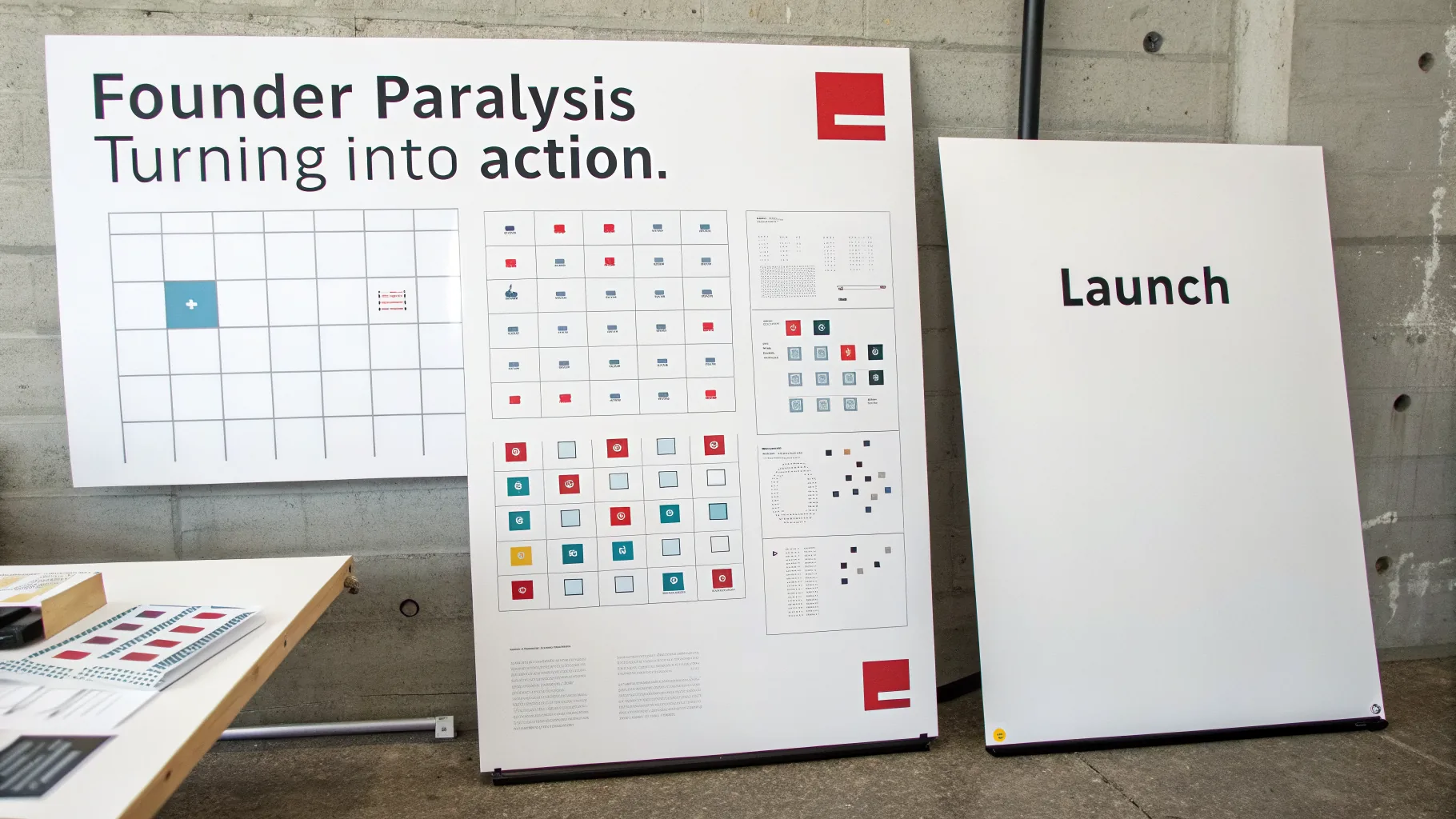
01Action Before Certainty
The breakthrough is usually smaller than people expect. It is not a grand system or a perfect stack. It is the moment you stop asking, “What is the best AI setup?” and ask, “What is one task I can run today?” That question changes the scale of the problem. Instead of solving your whole future workflow, you are testing one specific point of friction.
Once you do that, the work starts teaching you. You notice where prompts collapse, which tasks are repetitive enough to automate, and which use cases only sound compelling on social media. That shift matters because execution produces perspective. Before action, all roads are theoretical. After action, one road becomes measurable.
The practical payoff is not dramatic at first. It is directional. And direction is what most overwhelmed teams actually need.
Use friction as your starting signal
Do not begin with the tool everyone is praising this week. Begin with the task that repeatedly drains your attention and makes you think, there has to be a better way. If the task happens often, consumes more time than it should, and can be judged against a clear before-and-after result, you already have a valid test case.
That approach protects you from trend-chasing. It also gives you a fast feedback loop, which is the shortest path out of confusion.
Before execution
Before you act, every promising workflow stays abstract. Research feels productive, but the real constraints remain hidden. You are comparing imagined outcomes, imagined effort, and imagined quality, which makes decision pressure expand faster than judgment.
After execution
After you act, one path becomes visible. You can see where prompts fail, where repetition creates leverage, and where the task simply does not deserve automation. Reality becomes the filter, and measurable output replaces speculation.
Execution creates perspective. Before you act, every path is theoretical. After you act, one path becomes visible.
02What a Strong First Test Looks Like
What a measurable AI starting point looks like
A strong first use case is operationally boring in the best way. It repeats often, consumes more time than it deserves, and produces an output you can judge without debate. For non-technical professionals, that usually means narrowing the scope before increasing the ambition.
The five-step sequence works because it reduces cognitive drag at every stage. One task limits scope. A good-enough outcome prevents perfectionism from hijacking the process. Three experiments force comparison instead of intuition. Written notes prevent the next test from starting at zero. Repetition turns a lucky result into a dependable routine.
There is a strategic lesson inside that structure. Teams often want sophistication before they have reliability. They want orchestration, automation, and cross-tool workflows before they can consistently improve one narrow process.
Why the first attempt feels worse than expected
Starting does not create instant confidence. It usually creates discomfort first. The first attempt exposes bad assumptions. The second attempt shows you where your instructions were too vague. The third attempt may fix one problem while introducing another.
That sequence is not evidence that you are failing. It is the normal shape of learning when a system moves from imagination to use.
Why people quit too early
This is where many people quit too early. They interpret clumsy outputs as proof that the approach is wrong, when the better interpretation is that the boundaries were never clear enough. Reality is doing quality control for you.
If you let it, that pressure improves standards faster than passive consumption ever will.
What confidence actually starts depending on
The deeper shift is psychological. Confidence stops depending on perfection and starts depending on your ability to correct course.
You do not need a bigger system at the beginning. You need a shorter distance between effort and insight.
The sequence that reduces cognitive drag
Build trust in a small loop first, then earn the right to add complexity. Teams that skip this step usually accumulate more tooling than judgment, which makes later automation brittle rather than useful.
- One task limits scope.
- A good-enough outcome prevents perfectionism from hijacking the process.
- Three experiments force comparison instead of intuition.
- Written notes prevent the next test from starting at zero.
- Repetition turns a lucky result into a dependable routine.
03NOR-TIC's read
Analysis paralysis looks harmless because it creates no public mess. There is no awkward launch, no flawed deliverable, no obvious failure to explain. But quiet delay still has a cost. When information keeps entering the system and execution stays at zero, you enter an execution drought. The pipeline expands while judgment does not.
That is a dangerous imbalance. Every article saved, every tool bookmarked, and every workflow imagined increases the emotional weight of choosing just one direction. Instead of feeling better informed, you start feeling more fragmented. The irony is sharp: the search for certainty makes commitment harder.
Execution reverses that trend by shrinking uncertainty into something workable. Not eliminated. Just contained enough to act on.
Reduce the scale, not the ambition
Do not try to catch up to the entire AI landscape in one burst of effort. That instinct usually leads back to more tabs, more comparison, and less proof. Instead, choose a use case narrow enough to test this week and important enough to repeat next week.
Judgment is built incrementally. You do not need to become an expert overnight. You need to become slightly more capable than you were last month.
The most reliable confidence does not come from prediction. It comes from seeing what survives a real attempt. That is why we put so much weight on visible results over elegant theories. Planning still has value, but planning alone cannot tell you where context is missing, where standards are unrealistic, or where the workflow breaks under normal pressure.
Clarity usually arrives one layer later than people want it to. It appears after the attempt, after the awkward version, after the first correction creates something concrete to improve. That delay is not a flaw in the process. It is the process.
When the noise starts losing authority, your decision quality changes. You stop asking which option sounds smartest. You start noticing which one is actually helping.