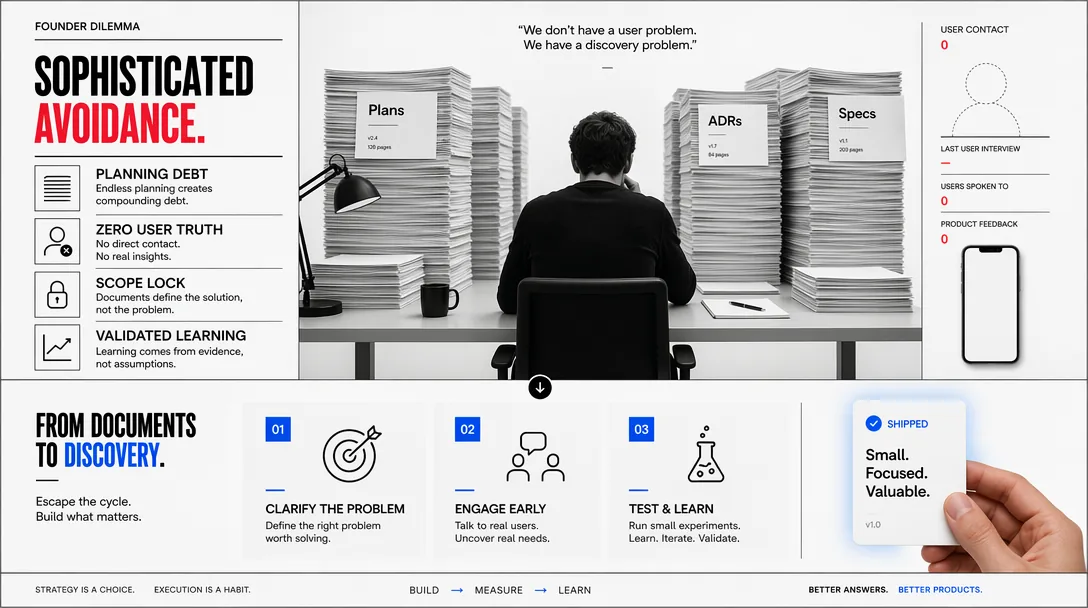
The Over-Engineer's Dilemma: 4 Days and 1,466 Lines Later.
Planning looked disciplined until it stopped producing contact with reality. The turning point came from cutting the product down to an Essential Wedge that a real user could actually touch, complete, and judge.
N NOR-TIC9 min read
Founder's Journal
AI
Strategy
Build in Public
Summary & background
Technical Context:
This Founder’s Journal entry comes from a familiar AI-product failure mode: abundant intelligence makes planning cheap, so founders overproduce internal coherence before they earn external evidence. Our position is simple: protect signal quality by shipping the smallest wedge that can create validated learning.
In this article4
Four days produced 1,466 lines of planning, 14 architecture decisions, a v3.2 interface spec, and a complete course structure. On paper, that stack looked serious. In market terms, it produced nothing that could be used, judged, or repeated. That gap matters more in AI-native products because the systems around the product can become articulate long before the product itself becomes real.
We see this pattern often in founder-led work: planning does not fail because it is sloppy. It fails because it is high quality. The documents are coherent, the logic is defensible, and every artifact justifies the next one. That is exactly why the trap is expensive. Visible artifacts create the feeling of progress while the business remains untouched by users.
The decisive question is brutal and clarifying: what evidence did the work actually create? Internal evidence can prove that the product is explainable. Only shipped experience can prove market contact.
The dangerous version of productivity is not avoidance. It is planning with momentum. One document creates a dependency on the next. The operating model needs architecture decisions, the architecture decisions need a cleaner interface spec, the spec reveals gaps in the course structure, and the course structure demands sharper positioning. Each step sounds responsible in isolation. Together, they can build a complete logic stack around an untouched product.
Founder-led work is especially exposed because no external operator interrupts the sequence. No product lead asks for a usable version by Friday. No customer success function shows drop-off. No engineer pushes back that the current stage does not warrant this level of system design. When the same desk generates both the ambition and the justification, self-reinforcing coherence can look exactly like disciplined execution.
That is why we treat planning volume as a weak signal. If the work does not create interaction, friction, or judgment from outside the founder’s own mind, it remains preparatory. Useful, sometimes necessary, but still pre-market.
Internal Evidence
Internal evidence tells you the idea is legible to yourself. You can explain the architecture, defend the logic, organize the scope, and narrate why each layer belongs. This is valuable for clarity, but it remains self-authored proof.
A founder can dramatically improve internal evidence in a week and still learn nothing about whether the current product deserves to exist in its present form.
External Evidence
External evidence starts when a user moves through the core flow. Input enters the system, output gets produced, friction appears, and value can be judged in the open. This is where demand, hesitation, and repeatability finally become measurable.
That shift matters because reality answers back. A product becomes commercially legible only when the market, not the founder, begins shaping the next decision.
Treat planning as inventory, not progress
When your artifact count rises faster than user contact, stop adding sophistication. Cut one layer immediately: a secondary flow, an explanatory framework, or a polished system component that only makes the concept feel complete in theory. Signal quality improves when the first shipped version is narrow enough to teach you something within days, not elegant enough to impress you in private.
Why AI products inflate scope before they earn a wedge
AI-native products carry a larger design surface from day one. You are not only shaping interface and workflow. You are also shaping prompting logic, memory, retrieval, orchestration, permissions, trust, onboarding, and outcome quality. That breadth creates a constant temptation to design the whole operating model early because the product feels intelligent and therefore seems to require an equally intelligent surrounding experience.
This is where many founders lose containment. A conventional software tool can sometimes ship rough because the value is visible in the mechanics. AI products invite abstraction. Teams start designing frameworks, logic layers, educational scaffolding, and future-state pathways before they have proved the smallest version anyone would return for. Here, scope escape is the default risk.
So we read the numbers differently. 1,466 lines do not prove seriousness. 14 ADRs do not prove maturity. v3.2 does not prove polish. In an early-stage environment, those numbers often indicate that optimization arrived before exposure.
1,466 lines
PLANNING OUTPUT
A large body of written logic created clarity, but no customer-facing proof. Volume increased confidence without increasing contact.
14 ADRs
DECISION LOAD
Architecture decisions accumulated before real usage made those choices worth optimizing. The sequence was orderly, but premature.
v3.2 spec
INTERFACE ITERATION
Multiple generations of interface thinking existed before generation one had been validated by a user in the wild.
02The Essential Wedge
The three-capability rule
The correction was not motivational. It was structural. We reduced the initial release to three non-negotiable capabilities and removed everything that did not directly contribute to the first undeniable outcome. This is the Essential Wedge: a protection mechanism against self-justifying design.
A constrained intake path that allows real source material to enter the product now, without optional branches or educational detours.
A usable processing flow that transforms that input into structured output through a path simple enough to survive first contact.
A clear outcome layer that shows users what they received, why it matters, and whether the result is worth repeating.
From total vision to first usable wedge
A wide early-stage vision narrows into three essential capabilities that create market contact.
Full Vision
Positioning
Architecture
UI Layers
Course Structure
Intake Path
Processing Flow
Outcome Layer
Connections
Full Vision → Positioning
Full Vision → Architecture
Full Vision → UI Layers
Full Vision → Course Structure
Positioning → Intake Path
Architecture → Processing Flow
UI Layers → Outcome Layer
Course Structure → Outcome Layer
Usable beats impressive when the goal is learning.
Once the wedge was defined, the work changed immediately. The product no longer had to explain its eventual sophistication, defend the architecture, or teach the operating model upfront. It had one job: produce a concrete result for a real person. That shift matters because premium experiences rarely win by revealing more machinery. They win when the method recedes and the outcome becomes undeniable.
This is the part many founders resist. They want the first version to justify the full vision. In practice, that instinct overloads first contact with explanation, naming systems, and optional pathways. Users do not reward internal elegance they cannot feel. They reward fast comprehension, a clean flow, and a result worth keeping. Less interface narrative often means more perceived product intelligence.
The initial shipped version was smaller than the plan and stronger than the plan. It had fewer pathways, fewer concepts, fewer exposed decisions, and fewer explanatory layers. That reduction did not make it complete. It made it teachable by reality.
The strategic shift is not cosmetic. Shipping replaces private certainty with observable behavior.
Decision Lens
Before Shipping
After Shipping
Primary question
Which structure is most coherent?
Where does the user hesitate?
Success signal
The product can be explained clearly
The user can complete the core flow
Optimization target
Elegance, scalability, completeness
Clarity, repeatability, outcome value
Type of feedback
Private and internal
Observed and behavioral
Strategic value
Builds confidence in the concept
Builds validated learning for the business
03What To Cut First
Secondary flows
Remove branches that make the product feel complete but delay first proof of value. A secondary path may look customer-friendly on a roadmap, yet it often introduces decision friction at the exact moment you need momentum. First-contact design should favor one strong path over several respectable ones.
Explanatory frameworks
Cut the educational layers that teach users how to appreciate the system before they receive a result. If the value only becomes legible after a conceptual tutorial, the wedge is still too wide. The product should demonstrate usefulness through the experience itself, not through a lecture about the machinery behind it.
Scale-oriented refinements
Avoid solving for imagined complexity before the core loop is alive. Naming systems, governance models, and highly polished internal structures feel prudent, but they often protect the founder from ambiguity more than they protect the user from failure. Keep only what preserves reliability in the very first repeated use.
Planning volume92
User contact0
Validated learning0
Shipped wedge34
The problem was not lack of work. It was the imbalance between internal effort and external proof.
Use a harder weekly question
Do not ask whether you made progress. Ask whether the week created validated learning. Did a real user complete the flow, generate output, hesitate at a visible step, or reveal what should disappear next? That question is less flattering than artifact count, but it gives founder-led teams the only form of momentum that compounds into better product decisions.
04NOR-TIC's read
There is a planning threshold most founder-led teams miss: the point where planning stops reducing risk and starts protecting self-image. The work still looks disciplined. The documents still seem responsible. But underneath, the founder is shielding the elegance of the idea from the asymmetry of user behavior. Real users ignore careful naming, misunderstand obvious value propositions, and expose confusion in places the builder considered settled.
That is why shipping improves the questions. Before release, the questions are architectural: which model is cleaner, which structure scales, which expression best reflects the broader vision. After release, the questions become commercial and behavioral: where does the user hesitate, which input creates the clearest output, what needs explanation, and what should disappear. Those are better questions because they cannot be answered privately.
The deeper lesson is not “plan less.” It is more demanding than that. Do not confuse planning volume with market contact. In a world where intelligence makes planning cheap, founders need stronger discipline around what counts as evidence. Ship the wedge early enough that reality can still change the product before the product hardens around an untested belief.