Strategic framing:
AI creates upside only when it sits on top of owned context. If your best thinking lives inside sessions you cannot reliably reuse, you are not building an asset. You are paying for temporary access to output.
Most teams think more subscriptions mean more leverage. In reality, value only compounds when your decisions, language, and patterns remain portable beyond any single interface.
AI creates upside only when it sits on top of owned context. If your best thinking lives inside sessions you cannot reliably reuse, you are not building an asset. You are paying for temporary access to output.
The biggest AI mistake in professional services does not look like failure. It looks efficient. You subscribe to a sharper tool, assemble a few prompts, upload a handful of documents, and feel current. Yet the moment you switch vendors, most of that progress vanishes. Nothing durable remains, because the underlying asset was never your intelligence system. It was rented convenience.
That distinction matters most when your income depends on judgment. If you charge $200 an hour or more for expertise, context, and trust, then losing reusable knowledge is not a minor workflow issue. It is margin erosion. Each reset forces you to rebuild language, recover reasoning, and reconstruct patterns you had already paid to learn through client work.
The wrong question is which tool to use next. The better question is what you intend to own. When the answer includes decision history, frameworks, recurring client patterns, and proven language, tool choice becomes secondary. The core challenge is building a layer that keeps paying you back after the session ends.
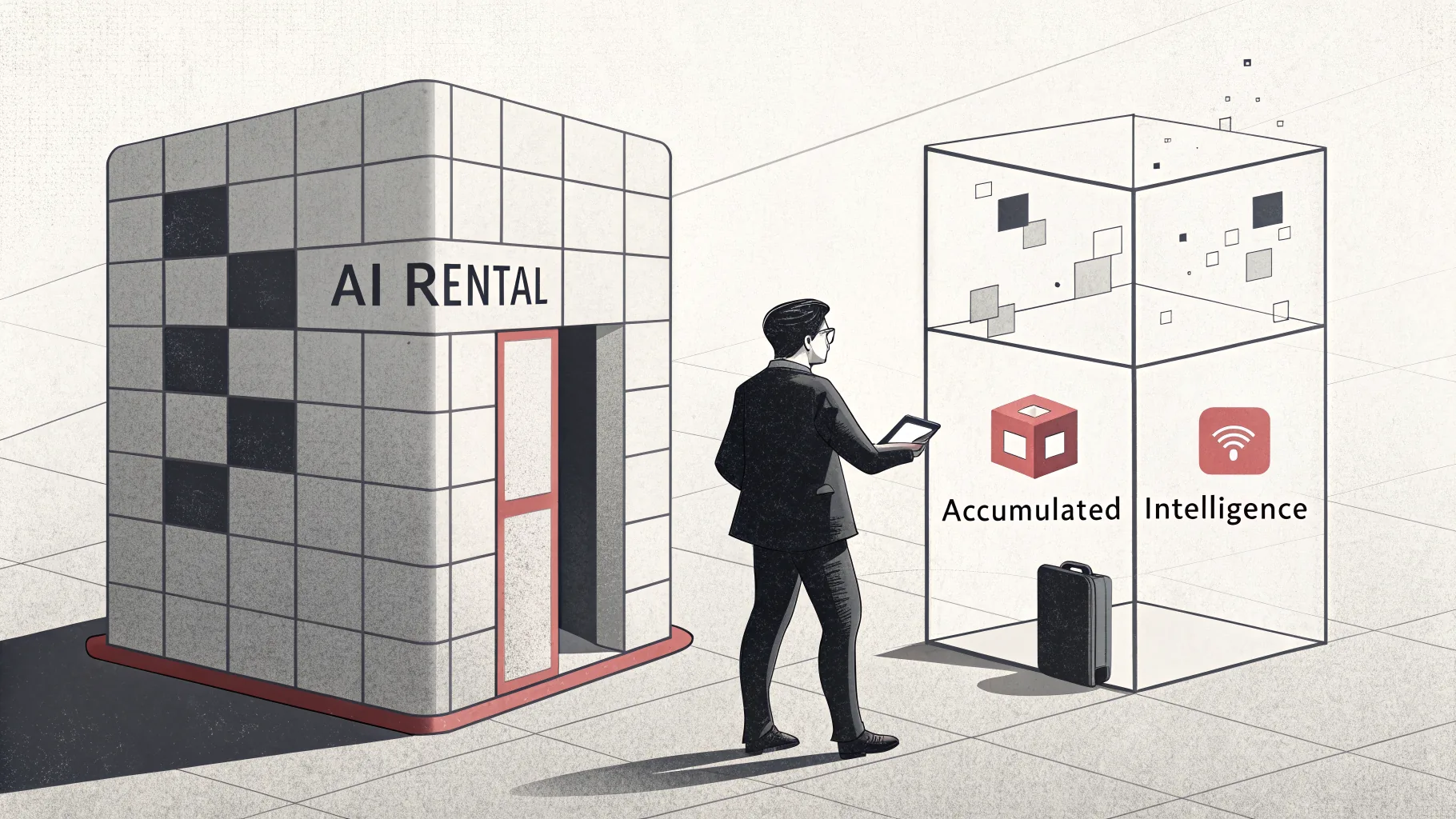
Most AI workflows fail quietly. A tool feels powerful for two weeks, then responses flatten, the setup becomes brittle, or pricing shifts. Another platform appears, and you migrate. On paper, that looks like adaptation. In practice, it often means starting from zero again with your own expertise scattered across notes, chat threads, folders, and memory.
This is why so many professionals feel busy but not cumulative. They are producing output without building memory. Their past decisions are not structured well enough to retrieve, their client language is not stored in reusable form, and their edge cases disappear into unsearchable conversations. Temporary usefulness keeps getting mistaken for compounding capability.
The cost compounds in reverse. Every reset increases dependency on fresh effort, and fresh effort is the most expensive input in knowledge work.
Rented AI workflow
Work happens inside chat sessions and vendor-specific features. Prompts may be saved, but the surrounding reasoning, client nuance, and decision trail remain fragmented. When you change tools, quality drops because the real asset never left the interface.
Owned intelligence workflow
Work is captured in portable notes, decision logs, templates, and structured assets outside the chat box. AI becomes an execution layer over your accumulated context. Changing tools may alter the surface, but the knowledge base stays yours and keeps improving future work.
If your best prompts, decisions, and reusable language live only inside one product, your revenue engine is exposed to vendor change. Start this week by identifying one repeated task where past thinking already exists, then move that thinking into a portable system you control. Revenue protection begins with retrieval, not with buying another interface.
$200+/hr
At this level, clients are buying judgment, context, and trust rather than raw production speed.
90 days
Small lapses in capture and retrieval begin creating visible friction over a single quarter.
12 months
Unmanaged knowledge starts reducing precision, speed, and recommendation quality over a year.
High-value professionals often underprice the role of knowledge management because it looks operational. Organizing notes, tagging files, and cleaning documents feels secondary compared with delivery. But that framing misses the financial reality. When your expertise is the product, protecting expertise is core work. The system that preserves your reasoning is part of the asset clients pay for.
Without that system, the same failures repeat in slow motion. You redo thinking you already finished. You forget why a past recommendation worked. You lose phrasing that once converted well. You restart research instead of extending it. None of this creates drama in a single afternoon, which is why teams rarely name it clearly. They just feel busier, less precise, and strangely more dependent on momentum.
The fix is not perfection. It is continuity. Capture what you already know in a form that can be retrieved, reviewed, and reapplied before the next similar decision arrives.
Ownership does not require training a model from scratch or building a complex technical stack. It means the useful parts of your work remain portable and reusable even if a vendor changes features, pricing, or direction. Portable context is the real threshold.
At minimum, ownership means your knowledge is captured outside the chat box and your decisions are stored with context. It also means your frameworks travel across tools, your language improves through repetition, and your past work makes future work better.
You do not need to invent insight from nothing. Valuable material is already produced every week through client emails, proposals, voice notes, project debriefs, sales summaries, meeting notes, research highlights, and repeated answers to repeated questions.
The opportunity is not content creation for its own sake. It is recognizing what useful thinking keeps disappearing after one use, then converting that thinking into reusable assets.
As AI becomes abundant, undifferentiated output loses scarcity. What remains difficult to copy is the combination of clear judgment, structured experience, and fast execution under real constraints.
That is why compounded experience matters more over time. The model layer becomes replaceable; your accumulated standards, decisions, and language become the durable advantage.
At the end of the day, note what you explained more than once, what decision may matter again, what language worked unusually well, and what pattern appeared across clients or projects.
Keep messy notes, transcripts, and observations in one layer, then promote the best material into frameworks, templates, decision logs, and answers you can reuse without rethinking from scratch.
Record the situation, the choice made, the reasoning behind it, and what happened next. Over time, this becomes a personal archive of judgment rather than a pile of disconnected facts.
Store prompts only when they produced reliable outcomes in live situations. Save the prompt, the context where it worked, the required input, and the output standard you expect.
Ask what became reusable, what repeated enough to deserve a template, what advice is still being written from scratch, and what patterns are emerging across engagements.
The cleanest starting architecture is simple enough to maintain and strict enough to preserve value. Use one capture location, one reusable asset layer, and one review ritual. Complexity can come later; retrieval discipline must come first.
5 ownership conditions
The most valuable intelligence in your business is usually not the model. It is the layer built from your own decisions, language, standards, and history.
| Raw material | What to preserve | Why it compounds |
|---|---|---|
| Client emails | Objections, phrasing, decision criteria | Improves future sales and delivery language without rewriting from memory |
| Proposal language | Positioning, scope boundaries, proof points | Raises consistency and shortens the path to high-quality drafts |
| Project debriefs | What worked, what failed, what changed | Turns experience into a reusable decision archive |
| Sales call summaries | Repeated questions and winning responses | Builds a living library of conversion-ready context |
| Meeting notes | Emerging patterns and unresolved constraints | Prevents rediscovery work and sharpens future recommendations |
Do not rebuild your whole operating system in a weekend. Pick one area where repeated thinking already exists now: discovery calls, investor objections, messaging tests, project approvals, or coaching stalls. Put it in one place, rewrite it so future-you can use it quickly, and review it before the next similar task. That is how small ownership habits become strategic leverage.
A linear workflow showing how scattered experience becomes a durable knowledge layer that AI can amplify without locking it inside one vendor.
In an AI-abundant market, generic output becomes cheaper first. That does not destroy value; it relocates it. The premium moves toward people who can combine clear judgment, structured experience, and fast execution with context. Those qualities are difficult to imitate because they are built through accumulated decisions, not downloaded from a model on demand.
This is also why identity matters in adoption. People keep using systems that feel like an extension of how they already think and work. They abandon systems that require them to keep reintroducing themselves. When your infrastructure reflects your own standards and history, AI strengthens your professional identity instead of flattening it.
The strategic test is simple: six months from now, will your current setup make you more replaceable or less? If the answer depends on a subscription remembering your business better than you do, redesign the system now.
Here is the most practical move you can make this week. Choose one stream of repeated thinking already running through your business. It might be the five questions in every discovery call, the investor objections that surface in most conversations, the creative rationale that gets approval faster, or the messaging tests that consistently outperform. Then centralize it, refine it, and reuse it before the next cycle begins.
That sounds modest because it is. Cumulative systems usually start quietly. But quiet systems often create the strongest strategic separation. When future work begins with remembered context instead of a blank prompt, speed improves, judgment sharpens, and trust grows.
You do not need more AI for its own sake. You need more continuity in your thinking. Own that layer, and every tool becomes more useful. Ignore it, and every tool eventually feels disposable.