Agent Access: Rethinking Trust in AI-Driven Systems
As AI systems move from answering questions to taking action, trust can no longer rest on a single login event. Durable security comes from controlling every handoff, every permission, and every acting identity in the chain.
N NOR-TIC10 min read
Strategy
AI Security
Delegation
MCP
Summary & background
Technical Context:
We design agentic security around bounded delegation, not portable user credentials. When chat, orchestration, agents, tools, and MCP layers all participate in execution, boundary quality becomes the control surface that determines whether autonomy scales safely.
In this article4
Agentic systems change the unit of trust. In a conventional application, a user request usually stays inside a relatively stable execution boundary. In an agentic flow, intent can move from chat to orchestrator, from orchestrator to specialist agent, and from agent to tools, APIs, or an MCP server. Every extra handoff creates another place where identity can be overshared, cached, replayed, or misunderstood.
That is why we treat agent access as an architectural discipline, not a login feature. The question is no longer whether the user authenticated successfully at the edge. The real question is whether each downstream action was performed by the right component, with the right authority, for the right duration. In agentic systems, trust is earned at runtime, step by step.
When teams miss this shift, they often extend old patterns into a new environment. A user token gets issued once and then travels everywhere because it is convenient. Convenience, however, creates a long corridor of reusable authority. The more surfaces that see the same credential, the larger the blast radius becomes when one layer leaks, logs, or mishandles it.
A user authenticates, a service receives the request, and authorization usually happens inside a more predictable request-response path. Identity stays closer to the point of entry, tool choices are narrower, and the execution graph is easier to reason about. Controls assume stability in both routing and privilege use.
Agentic Workflow Trust
A user request may pass through chat, orchestration, multiple agents, external tools, APIs, and MCP intermediaries before work is complete. Routing can vary across similar requests, and execution may cross several environments with different controls. Trust must survive non-determinism, repeated handoffs, and broader tool reach.
Three structural shifts make agentic security harder. First, there are simply more handoffs than in standard applications. Identity and intent now move through a chain of cooperating components instead of a single service boundary. Second, LLM-backed paths are less deterministic. Similar requests may produce different tool choices, sequences, or execution branches, which means teams cannot rely on one static approval map.
Third, agents are valuable precisely because they can act near sensitive systems. They are not passive interface layers. They can update records, retrieve documents, invoke workflows, and trigger operational changes. That broader tool access means authorization mistakes become operational mistakes very quickly. Capability without segmentation is where helpful automation turns into systemic risk.
Security controls built for static applications rarely fail because they are conceptually wrong. They fail because they assume fewer transitions, fewer actors, and fewer opportunities for authority to drift away from its intended purpose.
The two failures that matter most in agentic chains
The first failure is credential replay. Once a valid token appears across too many layers, an attacker no longer needs to defeat identity. They only need to reuse what the system already accepted. Tokens can surface in logs, traces, connector caches, model-adjacent memory, or poorly secured service boundaries. Replay risk expands silently because teams often underestimate how many components touch the same artifact.
The second failure is prompt-layer leakage, and this one is unique enough to deserve blunt treatment. An LLM is not a secure vault for privileged identity material. If tokens, secrets, or session artifacts become visible to prompts or model-accessible memory, they become vulnerable to extraction through malicious instructions, compromised intermediaries, or weak isolation. Probabilistic interfaces should never be treated as durable credential stores.
Design for the environment you actually have. If the system reasons in open-ended ways, keep credentials out of places where reasoning occurs unless you can prove containment, scope, and expiration.
Do not let reasoning layers hold standing authority
If a component only needs to plan, classify, or choose a tool, do not give it the user's broad credential. Separate the layer that decides from the layer that executes. That one design move sharply reduces accidental exposure, narrows replay value, and makes audits far easier when something goes wrong.
02Propagation vs Delegation
Full Token Propagation
The user authenticates once, then the same token is passed through chat, the orchestrator, an agent, the MCP layer, and the target tool. This is easy to wire up and superficially elegant. It is also a long corridor of reusable authority that crosses five trust boundaries and exposes one credential to every weak link in the chain.
Delegated Execution
The user authenticates once at the edge. The acting agent presents its own identity, requests short-lived permission for a specific action, and the receiving layer validates scope, audience, and expiry before execution. This is more deliberate to implement, but it delivers smaller blast radius, cleaner auditability, and tighter alignment between action and authority.
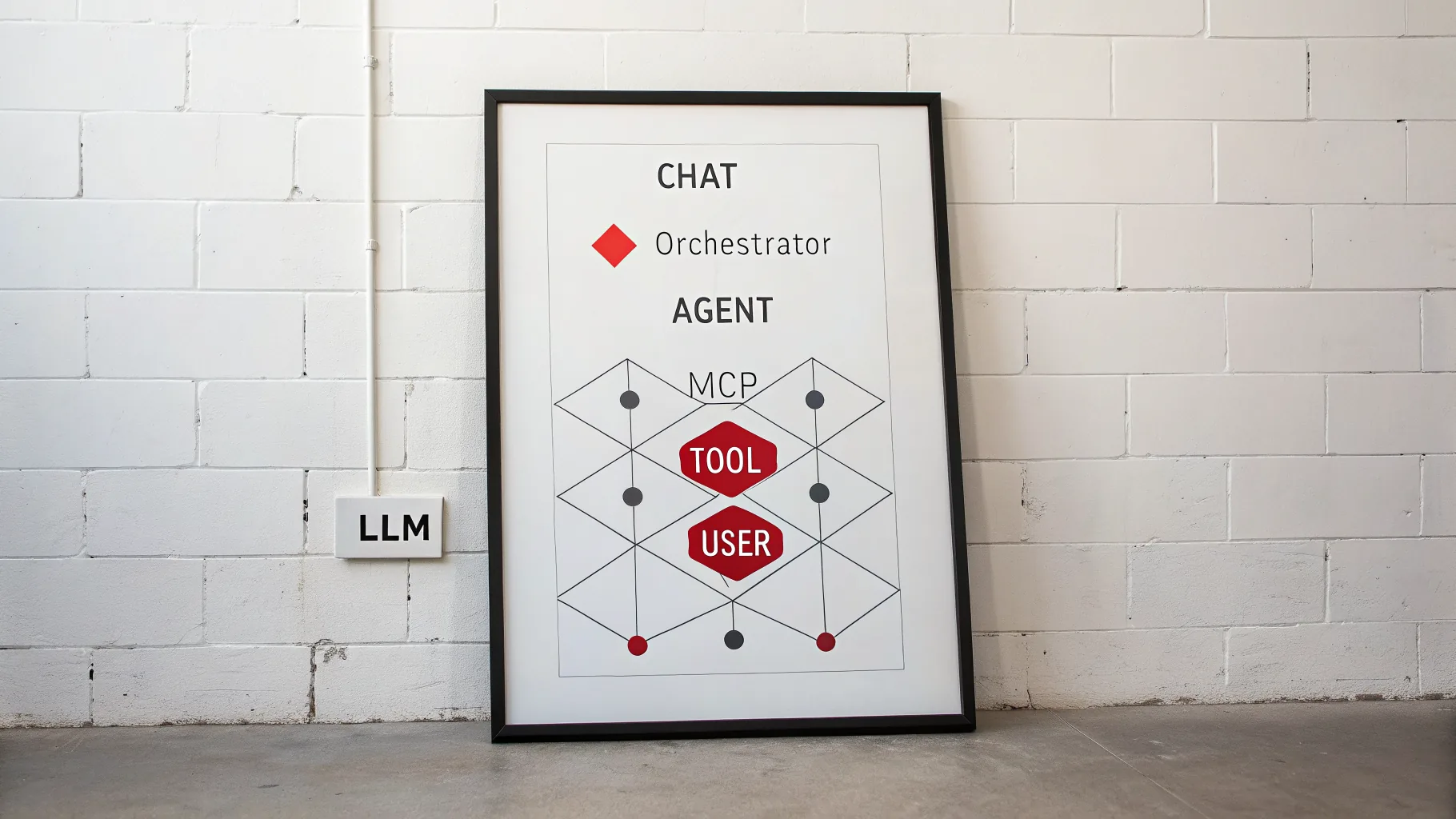
Chat, orchestrator, agent, MCP layer, and tool all become trust boundaries when a single credential is forwarded end to end.
3
MINIMUM SECURITY QUESTIONS
Map where tokens travel, identify who truly needs raw credential access, and verify whether each tool call can be traced to both human request and agent identity.
4
DELEGATION CONTROLS
Strong delegation depends on scope, time limits, audience binding, and traceability rather than broad credential portability.
5
FORENSIC CONTEXT FIELDS
A secure action should record who initiated it, which agent acted, which tool received it, what permission was used, and when it expires.
The operating framework for secure agent access
Step 1
1. Authenticate the human once
Use the identity provider at the entry point to establish the initial trust anchor. Keep the resulting credential as close as possible to that edge instead of turning it into a portable artifact for the entire workflow.
Step 2
2. Separate reasoning from authority
Let orchestration determine intent, choose tools, and plan actions without holding the user's full privilege set. Only the execution path should request access, and only for the exact task being performed.
Step 3
3. Give each agent a verifiable identity
Treat agents as accountable actors, not anonymous middleware. A receiving tool should know which agent is calling, under which delegated authority, and on whose behalf the action is being taken.
Step 4
4. Delegate the minimum necessary permission
If the task is updating one support record, issue scoped authority for that record or record class. Do not hand over a token that also enables exports, billing changes, or administrative operations.
Step 5
5. Bind every action to context
Secure execution answers five questions: who initiated the request, which agent acted, which tool received it, what permission was used, and when that permission expires. Missing fields weaken forensic clarity before an incident even begins.
What strong delegation must enforce
Delegation is stronger than propagation because it makes authority explicit at execution time instead of implicit everywhere else. The receiving component should never infer trust from possession alone. It should verify that the caller is the expected agent, that the permission is scoped to a specific task, and that the credential is both time-bound and audience-bound.
Issue short-lived permissions instead of forwarding long-lived user tokens
Bind delegated access to a specific service, tool, or agent audience
Record the original human request and the acting component together
Reject calls that cannot prove scope, expiry, and caller identity
4 core properties
Trust in agentic systems should not travel as a portable credential. It should be rebuilt at each handoff as constrained, verifiable permission.
03MCP as a Policy Layer
MCP matters because it formalizes how tools are exposed to AI components, and that makes it more than a convenience protocol. In a mature architecture, the MCP layer becomes a trust translation point. It should authenticate the calling component, validate delegated authority, enforce tool-specific controls, and preserve an auditable record of who invoked what.
This is where many teams make a costly mistake. They centralize access through MCP but leave policy thin, assuming routing alone improves control. It does not. A connector that only passes requests onward can just as easily centralize risk. Intermediation without enforcement creates a single place where weak assumptions compound.
Treat MCP servers and similar intermediaries as enforcement surfaces. If they cannot validate caller identity, scope, audience, and expiry, they are expanding the trust boundary without meaningfully governing it.
Secure delegated tool invocation
A flowchart showing how trust should move through an agentic workflow without propagating raw user credentials through every layer.
Tool Executes Specific Action → Audit Trail Linked to Human + Agent
A practical review lens for evaluating whether an agentic workflow was designed for portability or controlled delegation.
Control Question
Weak Pattern
Stronger Pattern
Where do user tokens travel?
Across chat, orchestration, agents, MCP, and tools
Held near the entry boundary while downstream access is delegated
Who is acting?
Generic service call or anonymous middleware
A verifiable agent identity with its own trust profile
What authority is used?
Broad user credential with excess privilege
Task-scoped permission for a defined action or resource
How long does access last?
Reusable token with wider replay value
Short-lived credential with rapid expiry
Can you investigate later?
Fragmented logs and ambiguous accountability
Traceable action linked to user, agent, tool, permission, and time
Where should teams start if they already have agents in production?
Begin by mapping the exact path of identity artifacts through your current workflow. Look for tokens in logs, traces, caches, prompts, connector layers, and model-adjacent memory. Then remove raw credential access from any component that only needs to reason, classify, route, or plan.
What is the clearest sign that a design is over-trusting tokens?
If the same user credential appears in multiple runtime layers because it felt easier than issuing bounded permissions, the design is over-trusting portability. The problem is not only excess privilege. It is that every additional copy creates another replay surface and another ambiguous accountability point.
Why does verifiable agent identity matter so much?
Without agent identity, tools only see a request, not a responsible actor inside the workflow. Verifiable identity gives each agent its own policy boundary and lets you distinguish human intent from machine execution. That makes approvals tighter, audits cleaner, and incident response faster.
A practical review sequence
Review your architecture in this order: edge authentication, token travel, reasoning layers, execution layers, MCP enforcement, then auditability. Teams often start at the model layer because it feels novel, but the most important security decision is usually made earlier. Design your limits, approvals, and recovery paths before expanding autonomy.
04NOR-TIC's read
The strategic shift is bigger than token handling. It is about redefining what counts as trustworthy execution when software plans, delegates, and acts across semi-autonomous chains. The strongest standard is not "was the user authenticated" but whether every action in the chain was performed by the right component, under the right constraints, with evidence you can verify after the fact.
That standard is more demanding, and that is precisely why it works. As agents gain broader access to business tools, organizations need trust models that scale with complexity rather than collapsing under it. Delegated access over credential portability is not a minor implementation preference. It is the difference between manageable autonomy and invisible accumulation of risk.
If you are designing agentic systems now, choose bounded permissions, verifiable agent identity, short-lived authority, and auditable handoffs as your defaults. Trust will not survive because credentials move efficiently. It will survive because authority is constrained tightly enough to let intelligent systems act without becoming impossible to govern.